Showing posts with label STCSA. Show all posts

Wednesday, 24 August 2016

Review: 'The 39 Steps'

Dunstan Playhouse, 19 August–11 September 2016. Adapted by Patrick Barlow from the movie by Alfred Hitchcock and the novel by John Buchan. Performed by Charles Mayer, Tim Overton, Nathan Page, and Anna Steen. Directed by Jon Halpin.


Melbourne Theatre Company’s Double Indemnity, a new play by Tom Holloway based on James M. Cain’s 1943 novella and directed by Sam Strong, has just closed at the Arts Centre’s Playhouse. Unlike Simon Phillips’ staging of Alfred Hitchcock’s North By Northwest last year for the same company, the play was widely regarded as a failure, if not a disaster, which must have come as a shock to MTC’s programming committee who had presumably gotten used to banking on adaptations of old noir thrillers after the critical and commercial success of North By Northwest.

But it was an earlier production that really set the mold: Patrick Barlow’s adaptation of another Hitchcock classic, The 39 Steps, which MTC presented in 2008 in a remount of Maria Aitken’s original London production. (South Australian audiences were given a taste of this sort of thing with Kneehigh Theatre’s Brief Encounter in 2013, and again the following year—albeit on a more modestly resourced scale—with five.point.one’s Notoriously Yours, in which Van Badham riffed off Hitchcock’s Notorious to fashion a lively script about the surveillance state). Barlow’s adaptation, as this new production by the State Theatre Company of SA attests, is a play with many lives, as improbably adept as its hero, the handsome but vacuous Richard Hannay, at overleaping fences and stopping bullets.

Perhaps where Holloway and Strong erred in their version of Double Indemnity was in cleaving more to Cain’s book than the 1944 film, which had the benefit of a screenplay by noir maestro Raymond Chandler. The 39 Steps, in contrast, adheres closely to Hitchcock’s film (only the most famous of three screen adaptations of John Buchans 1915 novel), replicating much of its dialogue and retaining almost all of The Master of Suspense’s innovations including the prototypical femme fatale Annabella Schmidt, absent from Cain’s all-male book.

Barlow’s most significant original contribution is a simple framing device that sees Hannay give suitably hardboiled monologues at either end of the show, a conceit that both recalls another noir classic, The Third Man, and helps to bridge the gap between performers and audience by knowingly placing us in his shoes: bored observers of life, drained by the daily horrors of the news, and longing for, as he puts it, ‘something mindless and trivial’. (Barlow also adds an explicitly Nazified bad guy, a tin-pot fascist in the mold of Oswald Mosley, in a move the playwright now regards as a chilling portent of the far-right’s new self-styled übermenschen, which—though it’s surprisingly easy to imagine Nigel Farage in a smoking jacket and monocle dragging on a cigarette holder—seems a longish bow to draw.)

Frivolous The 39 Steps may be, but the demands it places on its cast of four are considerable. In reproducing a film that involves dozens of characters, locations, and much technical wizardry—not to mention any number of planes, trains, and automobiles—they are required to juggle half a dozen arts at once (there is some literal juggling too, albeit sans balls) like the old vaudevillians they resemble when madly swapping hats and places in a splendidly frantic recreation of the film’s train chase sequence. Biplanes and marching bands are summoned via the rough magic of shadow puppetry, and cars are fashioned as though by improvisation from packing crates and a rostrum, all couched in the high energy of farce and the winking joy of meta-theatrical knowingness that brings us along for the ride by firmly engaging our imaginations. Barlow is a specialist at this sort of thing, having previously tailored the nativity, the French and Russian Revolutions, and even The Ring Cycle for casts as small as two, and there is, as director John Halpin notes in the program, a special pleasure in watching actors attempt the seemingly impossible, and failing and triumphing ‘in equal and hilarious measures’. (Halpin is no stranger to Barlow, having previously directed The Messiah for HotHouse Theatre and Queensland Theatre Company.)

Halpin’s cast, spearheaded by co-star of ABC TV’s popular Miss Fisher’s Murder Mysteries Nathan Page as Richard Hannay, is uniformly excellent. Page, in a characterisation that, unlike Robert Donat’s original, is more doltish than debonair, charms and repulses in equal measure, bouffant hairdo framing a strong-jawed, though open, even babyish face, that is permanently, and funnily, set in pokerfaced straight man mode. Anna Steen, though given lamentably little to do, impresses as the characteristically enigmatic femme fatale Annabella Schmidt, and later as Hannay’s cynical love interest Pamela Edwards. Charles Mayer and Tim Overton—the latter now, in this critic’s mind, firmly established as one of Adelaide’s finest young comic actors—skillfully inhabit a dizzying variety of roles, including an almost grotesque pair of Scottish hoteliers. I think it’s fair to say that the precision necessary to carry all of the gags full-term was not yet in evidence on opening night, and there are some dead patches that a simple injection of pace will probably remedy, but I’d be surprised if Tuesday night’s chuckles hadn’t become belly laughs by this time next week.

Ailsa Paterson’s set and costume designs revel in delightful period detail—I particularly liked the red velvet drapes, shell footlights, and polished boards highlighted during the London Palladium sequences—but the three wooden scaffolds, their platforms often obscured by an inelegant black screen, occasionally produce a claustrophobic effect that feels inappropriate. The production works best when the scaffolds are whisked away to allow the flying-in of various bits of scenery—mainly doors and windows—and the actors the space to work wonders out of nearly nothing. Geoff Cobham’s lighting ingeniously reproduces some of film noir’s most iconic effects—lots of hard light, silhouettes, and venetian blind slashes—as well as making good use of cinematic side lighting. Composer Stuart Day’s score works less well, kitschy where it ought to be moody, and beset on opening night by what seemed to me to be uneven levels and slipshod cueing.

Still, if it’s something mindless and trivial you want—and, let’s face it, who doesn’t at this perilous and precarious moment in history?—The 39 Steps delivers like a film noir patsy with the handle of a knife sticking out of their back.              

Wednesday, 20 April 2016

Review: 'Machu Picchu'

Sydney Theatre Company and the State Theatre Company of South Australia, Dunstan Playhouse, 13 April–1 May 2016. Written by Sue Smith. Directed by Geordie Brookman.

Photo: Brett Boardman

‘In the middle of our life’s journey, I found myself in a dark wood,’ begins Dante’s The Divine Comedy. The sentiment, although attributed to the author’s 35-year-old narrator, has an inclusive ring; we all, Dante seems to be saying, stumble into the selva oscura – the dark wood – sooner or later.

For playwright Sue Smith, the entrance to the wood was marked by a cancer diagnosis – non-Hodgkin lymphoma, the same cancer my oldest brother was lucky to survive as a child – in 2014. Smith’s play Kryptonite, a co-production by Sydney Theatre Company and the State Theatre Company of South Australia, was about to start rehearsals; the news that she was seriously ill must have arrived like a thunderclap, the first sign of a deluge that washes away all the old certainties.

In her new play, Machu Picchu, Smith transmutes her experience of cancer into a creakingly familiar scenario: a sudden, unexpected event – in this case a car crash – turns the lives of middle-aged, middleclass engineers Paul (Darren Gilshenan) and Gabby (Lisa McCune) upside down. The play opens with those lines by Dante, muttered by Paul moments before a stray kangaroo propels him into the depths of his own selva oscura with a ‘C6 incomplete spinal cord injury’.

Permanently disabled, and haunted by drug-induced visions while recovering in hospital, Paul’s pain and immobility kindle an existential crisis that was probably going to happen anyway. Incan engineering marvel Machu Picchu, with its remarkable cut stone infrastructure that ensured the famous ‘lost city’s’ endurance as a historical site, becomes the locus of Paul’s dashed dreams: he and Gabby had always meant to go, but now it is too late. Life, as they say, intervenes.

Smith knows how to write complex but humane dramas that, like a clear voice emerging from a loudhailer, project the narrowly particular onto the vertiginously universal. Kryptonite was, for me, a fine example of this kind of play, director Geordie Brookman’s epic theatre flourishes vividly exposing the vim and sweep of Smith’s deeply thought and felt inquiry into Sino-Australian relations since the Tiananmen Square Massacre.

Machu Picchu reunites Brookman with Smith, but the results are altogether more mixed. It’s said that the stones of Machu Picchu fit together without mortar so tightly that a knife blade still can’t penetrate the cracks between them – would that the same could be said of Smith’s play. Where Kryptonite was unerringly taut and outward-looking, Machu Picchu feels jerry-rigged and insular.

Watching it, I was reminded of critic Murray Bramwell’s observation about the middleclass plays of Yasmina Reza: that they are about less than they seem. Paul’s tragedy, however entertainingly leavened by Smith’s witty dialogue, rarely connects to the world beyond his and Gabby’s cocoon of bourgeois privilege. That Smith relentlessly satirises the indulgence and narcissism that are the fruits of this privilege – as in a scene set in a meditation retreat run by a stuttering guru (Renato Musolino) – only draws attention to the play’s circumscribed vision. Unlike in Chekhov’s tragicomic meditations on middleclass frustration, Smith’s characters only ever seem to be speaking for themselves.

This would matter less if Machu Picchu held together as well as Kryptonite, but unfortunately it doesn’t. More than one reviewer of the Sydney premiere season suggested that the play was a couple of drafts away from being stage-ready. I hear that changes have been made between then and its present run in Adelaide, but there remains much to be ironed out.

Neither the play’s flashbacks nor Paul’s hallucinations – indifferently staged in this production – provide much in the way of psychological insight, and the script abounds with improbabilities: not only does the guru pop up again, this time as a new-agey psychologist, at the hospital where Paul is convalescing, but so too does his daughter, Lucy (Annabel Matheson), who happens to be a nurse there.

It might fairly be asked, too, why Paul and Gabby have remained friends for so long with a couple as obnoxious as Kim (Elena Carapetis) and Marty (Luke Joslin), and with whom they seem to share little chemistry. A more significant question is that of who’s story Machu Picchu is; it feels, variously, like both Paul’s and Gabby’s, and the uncertainty twists out of focus the play’s themes: perseverance in the face of personal tragedy, and making the most of lives we know to be fragile and finite.   

Gilshenan and McCune, familiar from innumerable television roles, are well cast as Paul and Gabby, McCune successfully playing against type, Gilshenan impressing in his fearless uptake of Smith’s unsparing portrayal of disability’s physical and mental hardships. The smaller roles, anemically drawn, give the rest of the cast little to do except fill in the interstices of Paul and Gabby’s deteriorating relationship with broadly humorous brushstrokes. It’s tempting to wonder whether the two-hander form Smith applied with such success to Kryptonite might not have been fruitfully reemployed here, perhaps in combination with a set less grimly naturalistic than Jonathan Oxlade’s uninspired wall of hospital-green flats.

Machu Picchu strives to invite us to imagine our own sudden descent into Dante’s ‘deep place’, untouched by the sun. But Brookman’s direction, compassionate as it is, can’t make the leap for Smith – or for us. 

Sunday, 28 February 2016

Review: 'The Events'

State Theatre Company of SA, Belvoir, Malthouse Theatre and Adelaide Festival, Her Majesty's Theatre, 25 February-5 March 2016. Written by David Grieg. Directed by Clare Watson.  

Photo: Shane Reid

All art, the old truism goes, should ask questions rather than answer them. Scottish playwright David Grieg’s play The Events, loosely based on the 2011 Norway attacks, is abundantly enquiring. However, the interest generated by its moral and political conundrums is ultimately outstripped by a frustrating lack of either development or resolution.

Claire (Catherine McClements) is an Anglican minister in a small town. The multicultural community choir she leads becomes the target of The Boy (Johnny Carr), a disaffected right-wing extremist who guns down a number of the choir’s members in a vicious, unsparing attack. Claire, lucky to survive when The Boy found himself with only a single bullet and two potential victims holed up in the church music room, struggles to make sense of the events in their aftermath, spiraling into a destructive cycle of grief, psychological instability, and existential doubt.

Her quest for answers leads her to fraught encounters with psychologists, politicians, her partner, Katrina, The Boy’s friends and family, and, ultimately, The Boy himself (Carr embodies all of these characters with little physical or vocal differentiation, requiring some work on the part of the audience to ascertain who’s speaking in each scene, but it’s nevertheless a strong performance, grounded and attentive to detail, especially in Carr’s unsettlingly reasonable portrayal of the killer). Above all, Claire wants to know why.

‘I kill to protect my tribe from softness,’ The Boy intones chillingly, echoing history’s legion of masculinist butchers. For Claire, it’s not enough. Mad or evil, she insists on knowing. Is his father to blame, or the anti-immigration party of a Geert Wilders-style politico, or violent video games, or a crisis of masculinity? All familiar debating points that will resonate with different audiences for the same reason: the recurrence of the figure of the lone, white male killer, embittered and delusional, and, like Camus’ Meursault, estranged from mainstream society – Martin Bryant in Australia, Timothy McVeigh and countless others in the US. Grieg may have been thinking of the Norway attacks when he wrote The Events, but surely the Dunblane school massacre – perpetrated by another toxically aggrieved white man, Thomas Watt Hamilton – could not have been far from his mind either.

Perhaps overcompensating for The Boy’s conformity to this stereotype, Grieg throws the audience several curveballs. Both Claire and the killer are same sex-attracted, and their relationships to violence are startlingly reversed: we hear about The Boy’s defense of a young woman under assault by three men, and Claire’s infanticidal daydreams. On one occasion, she violently forces a kiss on Katrina then spits in her face. Is Grieg, in these moments, simply implying that everybody is capable of good and evil, that psychopathy is a spectrum and not a stable descriptor? If so, it seems trite in the face of the events. If not, these moments are difficult to read.           

Various contrivances and omissions prove similarly puzzling. It’s occasionally hard, for example, to swallow the choir’s endurance, and PTSD-affected Claire’s continued leadership of it. Claire’s unsegregated meeting with The Boy seems implausible (or is it another nightmare?). Given that she is an Anglican minister, we also learn surprisingly little of the nature of Claire’s faith. She is still a believer, apparently, although not in providence. ‘Do you pray?’ she is asked at one point. ‘Yes,’ she says. ‘Nothing.’ Claire’s flirtation with spiritualism, alienating to her choristers, reveals her dissatisfaction with mainstream faith, with its failure to provide her with either answers or solace after the massacre, but the audience is given scant sense of her religious journey. ‘Before I was good,’ is as much as she says. ‘Before I was happy’. Was she? There’s no way of telling.       

The play’s most striking conceit is the appearance, each night, of a different community choir on stage that functions, albeit in a limited way, in the manner of a Greek chorus (there’s also a Brechtian touch, with members roleplaying from time to time). It’s a device that neatly inverts the divisive tribalism evinced by The Boy, reminding us of the suturing power of community and of music (it’s telling, of course, that Claire instinctively fled to the music room to escape the shootings even if, in the end, it proved a sanctuary only for her). Sharply directed by Carol Young and performing traditional hymns as well as contemporary pop songs, in addition to original music by John Browne that lightly comments on the action of the play, the rough energy of the choir (the wonderfully named La La Land on the night I saw it) is a delight.

Catherine McClements is excellent, a finely measured account of Claire’s emotional and spiritual bewilderment happily banishing memories of a storied film and television CV. Geoff Cobham’s plain set – steel-frame chairs and battered upright piano evoking a dusty church hall – nicely complements Clare Watson’s unembellished direction, and is lit by his own design that makes effective use of both warm washes and chilly, driving followspots.       

Theodor Adorno wrote that ‘the finished work, in our times and climate of anguish, is a lie’. It may be that The Events says no more than this: that closure is an impossibility, because finally life – and death – resist reason, and can never be fully understood. However appealing this view is in the age of ISIS, Syria and the world-as-battlefield mentality of a US empire in its death throes, it’s an unsatisfying foundation for drama, and one that, perversely, risks aping the nihilism it identifies in its subjects.

‘Sometimes shit just happens,’ one of Grieg’s characters says. But there’s a difference from being usefully discomforted by this thought, and being convinced that it’s more profound than it sounds. A lot of shit just happens to Claire over the course of The Events, too much of it inscrutable, too little that adds up to a clear and compelling trajectory. No doubt the play is an assertion of the good of community, of the coming together of disparate people in the name of a shared sense of belonging (and, by extension, of the good of theatre itself). But the play also reminds us that none of these things – even if within them might reside the source of our recovery and our redemption – is of itself capable of stopping a hail of bullets.

Maybe The Boy needs a name. Maybe the play’s brevity (it runs for just over an hour) is constrictive. In any case, we are left with a jumble of questions – puzzle pieces set out in front of us as Watson puts it in her director's note, only there’s no picture on the box to guide us in their assembly. Why?

Wednesday, 27 May 2015

Review: 'Masquerade'

Griffin Theatre Company and State Theatre Company of South Australia, Her Majesty's Theatre, Adelaide, 20 May-31 May 2015. Adapted by Kate Mulvany from the book by Kit Williams. Directed by Lee Lewis and Sam Strong.

Photo: Brett Boardman

In the 1970s, English children’s author Kit Williams was challenged by his publisher to “do something no one has ever done before”. The result was Masquerade, a visual puzzle- and riddle-filled picture book about a hare’s quest to unite the Moon and the Sun with the aid of a jeweled golden hare. On the book’s publishing in 1979, Williams created a minor sensation when he announced that he had buried a real golden hare – an 18 carat pendant, sculpted by the author himself – somewhere in England, and that the clues to its whereabouts were scattered throughout the book. Thousands participated in the search for the hare, which culminated (ultimately controversially, when insider knowledge was alleged a few years later) in Ken Thomas winning the contest in 1982.   

The book’s popularity, however, extended beyond Williams’ native England, its elaborate paintings and innovative ‘armchair treasure hunt’ format finding significant audiences in many countries – including Australia (though a warning about acquiring a copy today: you may have to embark on a treasure hunt of your own, as I hear that the book is long out of print). One of Masquerade’s most avid antipodean admirers was Kate Mulvany, now an actor and playwright. Mulvany was suffering from childhood cancer when a woman named Tessa read the book to her at her bedside, making, according to Mulvany’s program notes, “the timelessness of a children’s oncology ward somehow bearable”. Williams set two conditions for Mulvany’s stage adaptation of Masquerade – that it be “for nine to ninety year olds”, and that the story of her illness and friendship with Tessa be included.       

Mulvany meets the second condition with what, at first, is a parallel narrative. In the world inhabited by ‘mortals’, Tessa (Helen Dallimore) reads the book of Masquerade to her son, Joe (Louis Fontaine/Jack Andrew), who is largely confined to a hospital bed. Joe hasn’t been outside for days; Tessa, tired and frazzled, seems to long to escape almost as much as Joe. Around the ward – in Anna Cordingley’s design, a curtained box on a much-used revolve in the centre of the stage – Jack Hare’s (Nathan O’Keefe) fantastic quest to deliver a message of love from the Moon (Kate Cheel) to the Sun (Mikelangelo, whose Balkan gypsy music-inspired Black Sea Gentlemen provide the show’s live music) plays out.

Known as the ‘Celestial World’, this realm couldn’t contrast more with the drab, time-slowing mundaneness of Joe’s oncology ward surroundings. It is filled with colour and motion, and peopled with bizarre characters like the extravagantly-attired ‘collector of dreams’ Tara Treetops (Cheel) and her talking crow, Craw, and a lisping, lusciously-coiffured Isaac Newton (Pip Branson), unfazed by seeing his law of universal gravitation, well, suspended. In the play’s third and final act, Joe and Tessa – dismayed by Jack’s dim-witted blundering and his losing of the Moon’s love token, the golden hare pendant – enter the Celestial World to find the jewel. (The book effectively ends at this point, leaving its readers guessing; Mulvany’s third act is an entirely original contribution.) They have little to go on except Masquerade’s recurrent riddle: “Fifty is my first/Nothing is my second/Five just makes my third/My fourth a vowel is reckoned/Now to find my name/Fit my parts together/I die if I get cold/But never fear cold weather”.

Photo: Brett Boardman

O’Keefe, substantially reprising the deft physical comedy he brought to Windmill’s Pinocchio last year, engages and delights as Jack. Equally skillful and charismatic are Cheel and Zindzi Okenyo, the latter playing the Celestial World’s Penny Pockets and sundry characters including, hilariously, the terpsichorean Fat Pig (it would seem that no dimension is safe from Gangnam Style). Louie Fontaine appeared as Joe on opening night, giving a more than creditable account of a demanding role that includes some singing (“I dream of outside…”). Dallimore, as Tessa, is not as impressive – inexplicably cold and dour for much of the time – but brings her noted musical theatre skills to bear on the show-stopping Tessa’s Dream.

Williams’ book proves to be a somewhat problematic vehicle for a stage show, its selection made, I suspect, more on account of Mulvany’s understandable attachment to it than any compelling theatrical potential. In the first place, the solution to the book’s central riddle is text- and picture-based and can’t, despite the production design’s nod to Williams’ page borders containing stencilled letters, be effectively replicated on stage. Similarly, something substantial feels lost in translation between other aspects of the book – such as its ornate pictorial style, and English folk-infused surrealism – and this production, which, under the direction of Lee Lewis and Sam Strong, often feels hyperactive rather than adventuresome, jumbled rather than whimsical.

Chris Petridis’ audio-visual design, incorporating animated projection, is striking but underutilised. Mulvany’s dialogue, while amusingly metatextual and never patronising, is undoubtedly overwritten in places, and Williams’ edict that the play be for “nine to ninety year olds” occasionally rather too clearly shows through, especially in the tonally uneven first half. This is not to say that the play’s darker aspects are unwelcome – Joe’s illness, and themes of love, mortality, and family are commendably straightforwardly handled – but simply that Williams’ brief was perhaps a deceptively challenging one, its results surprisingly charmless rather than universally entertaining.

Monday, 20 April 2015

Review: 2015 Adelaide Festival

Beckett Triptych: State Theatre Company of SA, State Theatre Company Scenic Workshop and Rehearsal Room, 20 Feb-15 March. Directed by Corey McMahon (Eh Joe), Geordie Brookman (Footfalls), and Nescha Jelk (Krapp’s Last Tape); SmallWaR: SKaGeN, Space Theatre, 2-4 March. Written and performed by Valentijn Dhaenens; La Merda: Marta Ceresoli, Richard Jordan Productions, and Produzioni Fuorivia, Space Theatre, 5-8 March. Written by Cristina Ceresoli, performed by Silvia Gallerano; riverrun: TheEmergencyRoom, Dunstan Playhouse, 26 Feb-2 March. Adapted, directed, and performed by Olwen Fouéré. 


Photo: Shane Reid

Whether through the vagaries of curatorial taste, the spectre of economic austerity, or some untraceable shift in the theatrical ether, the actor in brutal isolation – tethered almost solely by text to stages dimly lit and emptied of relieving or easily symbolic dressing – dominated this year’s Adelaide Festival of the Arts.
  
Beckett Triptych

The State Theatre Company of SA’s offering, Beckett Triptych, locates its three onstage soloists – Pamela Rabe (Footfalls), Paul Blackwell (Eh Joe) and Peter Carroll (Krapp’s Last Tape) – within the crepuscular atmospherics of the Company’s subterranean Scenic Workshop and Rehearsal Room spaces. The audience, ushered between venues like visitors to the underworld, is divided in half for the first two ‘dramaticules’, which run twice in succession, then reunited post-interval for the climactic Krapp.

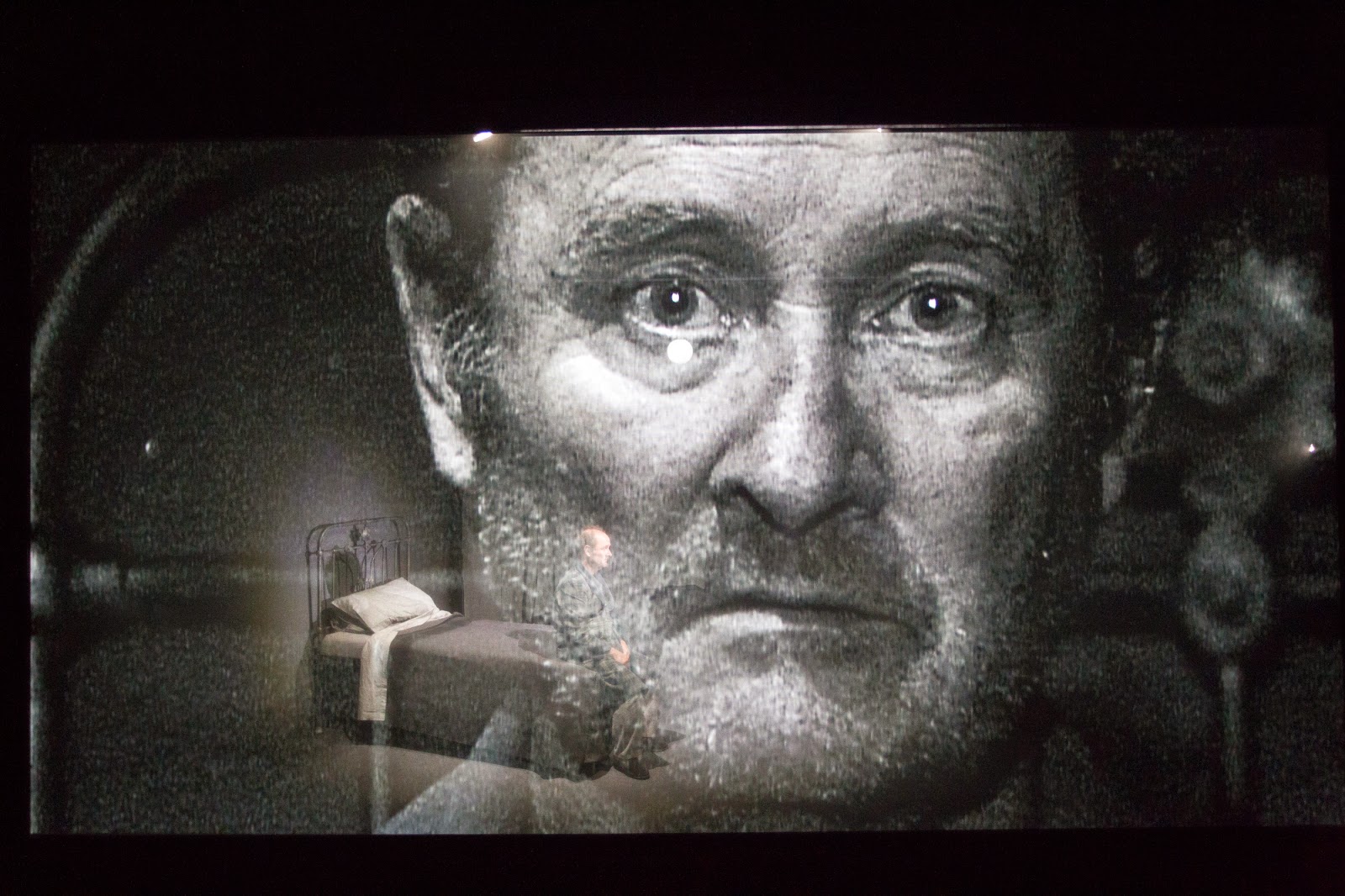
In Eh Joe, we watch through a scrim as Blackwell, in his ‘stinking old wrapper’ of worn dressing gown and slippers, shuffles paranoiacally around Ailsa Paterson’s monochromatic, vaguely fabulist set that telescopes weirdly towards an upstage door. He checks under the bed – no monsters there – then slumps onto its end, submitting to some expected but unspoken consequence of bringing his body to rest. There he remains in silence for the remainder of the play as a woman’s disembodied voice (Rabe) torments him about his lascivious past and barren present, her clipped, accusatory voice an aural waterboarding. Joe’s face, crumpled and impassive, is projected via a video camera onto the scrim in a series of increasingly extreme close-ups. Finally, just his eyes – unnervingly massive and miraculously unblinking – fill the screen, windows onto a soul in ineffable anguish.

Director Corey McMahon’s montaging of live action and projected image, though not innovative (Canadian film-maker Atom Egoyan employed both scrim and video feed in his 2006 production for Beckett’s centenary celebrations), is nevertheless an effective solution to staging a play originally written for television, its disturbing intimatisation of a mind under remorseless psychic assault undiminished by the shift in medium.

Like Joe, Footfalls’ May is persecuted by ghosts from a neurotically reproduced past; the present, as a result, is rendered a sleepless purgatory. ‘Will you never have done…’ the voice of May’s mother (Sandy Gore) asks in the low, drawn-out timbre the characters familially share, ‘revolving it all? In your poor mind’.

Rabe looks like the ‘tangle of tatters’ to which May elliptically refers, face drawn and pallid, hair overlong and disheveled (the only mistake is the Victorian-style dress, a too elaborate and loaded an interpretation of Beckett’s call for a ‘worn grey wrap’). But for the audible, mathematical tread of her feet on the worn strip of floor beneath her, Rabe is spectral in Ben Flett’s narrow, starkly contrastive lighting. She looks, occasionally, monstrous as she leans disfiguringly out of the light, or like the tortured figure in Munch’s The Scream as her mouth yawns soundlessly open. Here, perhaps more than in any of Beckett’s other short plays, the role of the director is akin to that of a conductor – the rhythmical progression implied by the play’s title and inherent in its text demands to be both physically and verbally realised – and in this Geordie Brookman keeps time admirably.   

It’s somewhat mystifying that Footfalls is followed in the triptych not by That Time, written specifically to accompany it, but Krapp’s Last Tape, the longest and most familiar of Beckett’s shorter plays for the stage. It stands apart from the other two pieces presented here in other ways too, namely that Krapp’s private perdition (for what are each of these plays but inversions of Sartre’s dictum that hell is other people?) is ultimately, if incompletely, reconcilable: ‘Perhaps my best years are gone,’ he says, ‘but I wouldn’t want them back. Not with the fire in me now’.  

This impression is strengthened by Carroll’s performance as Krapp, in which, under the direction of Nescha Jelk, the clowning Beckett minimized in his later revisions of the play is fully reinstated. The result is a slightly fussy, childlike Krapp, less visibly haunted than in many previous incarnations that, however unreliably remembered, cannot be easily forgotten – Patrick Magee, John Hurt.

While at times I yearned for more of the gravitas those actors brought to the part, at least neither Carroll nor Jelk mistake ponderousness for insight, a trap both lesser and greater interpreters of Beckett have succumbed to. The production’s one true shortcoming is Paterson’s overdesigned set, a crudely symbolic and needlessly focus-pulling array of middens on trolleys that threatens to overwhelm the only detritus of moment, that of the ultimate unreconstructed hoarder, the human mind.    
         
SmallWaR

It is the body, at least at first, that is the site of trauma in SmallWaR, a companion piece to Belgian writer/performer Valentijn Dhaenens’ BigMouth that substitutes the earlier play’s cast of powerful, militant orators – Patton, Goebbels, George W. Bush – for one of doomed youth, ordinary soldiers destined to die, in Wilfred Owen’s words, ‘as cattle’.  

A truncated gurney is wheeled onto the stage in front of a giant scrim by Dhaenens, dressed in the starchy, army green uniform of a World War I nurse. Fixed to the bed is a flat screen TV on which pre-recorded vision plays: Dhaenens again, this time a limbless, prostrate soldier, only his head and shoulders visible atop crisp white sheets. He is silent and motionless. The nurse sings softly: ‘There was a boy, a very special boy’. Multiple, ghostlike duplicates of the soldier peel away and cross the stage to answer a phone, the almost seamless transition between video and projection stunning. On the other end of the line are fathers, mothers, lovers – each voiced with skilful differentiation by Dhaenens – who, as with the letters and memoirs which form the basis of much of the script, wrestle with war’s teleology as well as its lived reality. ‘When you look death in the face,’ one of the soldiers muses, ‘do you think of democracy, freedom and honour?’

There is, refreshingly, little here in the way of simplistic anti-warism, but a late, awkward turn into a seemingly unironical jingoism – evidenced by, for example, the appearance of the words ‘It is sweet and right to die for your country’ – propels the work too far in the opposite direction. It was Owen, after all, who called Horace’s phrase, originally set down in Latin in Odes, ‘the old lie’.   

La Merda

A woman (Silvia Gallerano) perches naked on the edge of a tall, pedestal-like chair, clutching a microphone into which she is mumbling the words of what sounds like the Italian national anthem. Her lips, quivering and almost cartoonish, are bright red, her body pale and unforgivingly exposed in the cold glare of multiple spotlights. ‘Yes I’m a small one,’ she says, pianissimo, in the first of the three movements (and one counter-movement, ‘Italy’) that make up Cristian Ceresoli’s monologue, ‘and I’ve got these thighs of mine but still I never quit and never give up’. An actor in desperate pursuit of fame whose fascist father killed himself when she was thirteen, she has the rusted-on look of someone on the verge of a breakdown or, perhaps, a breakthrough that never quite arrives. The howling, narcissistic crescendos (‘me, me, me, meeeeeee’) that end each movement, plunging the theatre into darkness and silence, presage a negation of the self that can only be brief and temporary – the ego, insatiably hungry, must always return to cannibalise its host.

Photo: Valeria Tomasulo

La Merda (in English, The Shit) is not, however, merely an atomistic study of neurotic obsession with body image and celebrity. It reveals, through the actor’s grotesque evocations of various men – an odious TV director, her father, sexual predators in school and on the subway – a culture of nationalistic masculinity that connects the Italy of Garibaldi to those of Mussolini and Berlusconi, a lineage that traces the country’s journey from, in Pasolinean terms, a fascist to a consumerist totalitarianism. ‘The male sex our flag, the male sex our flag,’ Gallerano spits at the conclusion of the monologue before clothing her body in a green, white and red flag – an ambivalent gesture freighted with both embracement and resistance. A charged silence hardens, after what seems like a minute or more, into a standing ovation that justly rewards a performance of startling intensity and import.
  
riverrun

Olwen Fouéré, adapter, director and performer of this one-woman interpretation of the voice of the river in Finnegans Wake, has described James Joyce’s modernist apogee – ‘admired more often than read, when read rarely through to the end, when read through to the end not often fully, or even partially, understood’, according to Anthony Burgess – as ‘a seam of dark matter somewhere between energy and form, music and language: the trace of a boat on an endlessly changing surface’. Fouéré, in a virtually uninterrupted monologue that freely splices together passages from all over Joyce’s infamously sprawling text, is at once vessel and waterway, embodying both the river’s sinuous, dreamlike course that ultimately circles back on itself (the novel’s final sentence, which has no period, leads back to its first word, riverrun, which has no initial capital) and the shadowy characters who drift and drown in its currents.        
  
Coiled, shifting like a prizefighter on the balls of her feet, Fouéré begins with a dawn prayer, three words in Sanskrit that are found in Finnegans Wake at the opening of Book IV, the beginning of the novel’s final section: ‘Sandhyas! Sandhyas! Sandhyas!’ The jagged stand of Fouéré’s microphone and its lead’s tracing of the edges of a vast patch of chalk evoke the uncertain, meandering quality of the flow of bodies of water, but it is the topographies of the body and of language that are foregrounded here. Joyce’s multilingual, polysyllabic wordplay is given endlessly fluid shape by Fouéré’s sinewy, gestural physicality and almost schizophrenic vocalisations. She hisses, growls, murmurs, sings, and, quite literally, breathes the river – Dublin’s Liffey, personified in Finnegans Wake in the character of Anna Livia Plurabelle – into life.

The elusiveness of Joyce’s text is unquestionably amplified in its transition to the stage. The audience member, unlike the reader, never has the luxury of pausing its inexorable flow to dig deeper into its strata of meaning, or to fully unpack its complex puns or allusions to Irish history. But, as Beckett, a close friend and aide of Joyce’s, noted, ‘[Joyce's] writing is not about something; it is that something itself”. That something is, in essence, a dream conveyed through language rendered as music, and it is in the splendid, endless noise of Fouéré’s furious unintelligibility that the pleasures of riverrun arise.

 An edited version of this review appeared in RealTime issue #126.

Wednesday, 5 March 2014

Adelaide Festival review: 'The Seagull'

State Theatre Company of South Australia, State Theatre Company Scenic Workshop, 21 February-16 March 2014. Written by Anton Chekhov, adapted by Hilary Bell. Directed by Geordie Brookman.

Photo: Shane Reid

‘Little action, tons of love’ was how Chekhov described his new play The Seagull in a letter to Aleksey Suvorin in 1895. In this State Theatre Company of South Australia production, using an adaptation by Australian playwright Hilary Bell, there is ample inaction but not nearly enough love.

For the second time in two years, the STCSA’s scenic workshop has been pressed into service to stage a Russian classic (the other, a reworking of Tolstoy’s novella The Kreutzer Sonata, was, incidentally, among Chekhov’s favourite pieces of fiction). The space – dark, musty and acoustically flat – has a hole-in-the-wall feel which is seemingly at odds with the faded but still felt opulence of Chekhov’s middle class world. The surprise is that it works, refreshing a century-old play by paring back its naturalism.

The action is lent the same charmingly crude theatrical effects as The Seagull’s play within a play, director Geordie Brookman further thinning the naturalism by, for example, having the bad weather of the second half denoted by a traditional wind machine and the actors throwing handfuls of white confetti above their heads for snow. The play’s two-year time lapse is signified by a caption attached to the back of an actor’s coat, the word ‘LAKE’ is printed in large black letters on the sliding door which is periodically opened to reveal the play’s key backdrop, represented by nothing more corporeal than a wash of blue-white light and swirls of dry ice.

When the audience enters the space, Medvedenko (Matthew Gregan) is serenading Masha (Matilda Bailey) on a parlour guitar as she fights to erect the heavy outdoor chairs for Konstantin’s (Xavier Samuel) play. (I should say here, as my only note on Bell’s otherwise competent adaptation, that the decision to dispense with the play’s famous second line – usually translated as ‘I am in mourning for my life’ – was an unwise one. The banal exchange with which she has replaced it has none of the arrestingly graceful poetry of the original). There are platforms at either end of the traverse stage, one comprising Konstantin’s playing space, obscured initially by a dark brown curtain, the other the interior spaces of Sorin’s estate, demarcated by the rolling out of various rugs. Designed by Geoff Cobham, all of this is elegantly simple and works, as it should, to maximize the audience’s attention to the performers.

The large ensemble, packed with STCSA stalwarts including Paul Blackwell, Terence Crawford, Lizzy Falkland and Chris Pitman, is strong and connected. Samuel, in overlong shirtsleeves and raffishly askew hair, is a suitably angsty Konstantin, though we have to wait until the play’s second half to see the best of him as he finds more of the melancholy and less of the vituperative excess in the part. Rosalba Clemente, in her first STCSA role in ten years, both dazzles and terrifies as the desperately insecure prima donna Arkadina. Renato Musolino’s Trigorin remains engagingly enigmatic even as his role in fulfilling the dark promise of the symbol of the seagull is exposed. Much less effective are the younger women in the cast. Matilda Bailey’s Masha is perversely dotty, while Lucy Fry in the crucial role of the ingénue Nina is unable to bring either the necessary allure to the first half of the play, or pathos to the second.

Where this production errs is in its pace, which always seems about thirty per cent too slow, as though Brookman has mistaken the play’s lack of dramatic action for, simply, a lack of drama. Lifelessness, rather than emphasis, fills this production, the powder keg passions of Chekhov’s characters undermined by a feeling of enforced languor. The transitional songs, sung live by the cast to Gregan’s accompaniment, contribute to the problem by borrowing too heavily from the current mania for soporific acoustic pop of the Jason Mraz variety. There are, I think, other missing or imperfect connections, from, for example, Nina’s final speech to Chekhov’s deeply embedded sense of irony, and from the exaggerated awfulness of Konstantin’s play to his psychological turmoil.

There is much to commend in this plain rendering of a play that, as recently as 2011 in this country, has seen many radical interpretations. Even in translation, the clarity and penetration of Chekhov’s feeling for the causes and consequences of human sorrow easily comes down to us through the decades. The Seagull’s great challenge – one which this production is not quite dynamic enough to meet – is that it is a comedy in which nobody is happy. That is life, and there is just not enough of it in this production to make it a great rather than good one.